
Two people start their journey to parenthood with new hope and excitement. They mark fertility days on the calendar, discuss baby names, and imagine a new chapter in their lives. But all these hopeful marks turned into disappointment when the pregnancy test showed negative results. And questions rise in their minds, “Why does every month …


Two people start their journey to parenthood with new hope and excitement. They mark fertility days on the calendar, discuss baby names, and imagine a new chapter in their lives.
But all these hopeful marks turned into disappointment when the pregnancy test showed negative results. And questions rise in their minds, “Why does every month end with the same results? Is there anything we are missing? Is our body trying to signal something?”
Also, questions from relatives and society can add to couples’ emotional stress. As a fertility specialist, I see many couples continue waiting instead of finding the cause. Your body gives some signs that may indicate you have an underlying fertility-related condition.
Understanding when to see a fertility specialist can help identify problems early and guide you toward the right support and treatment options.
What Is Infertility?

Infertility means, in simple terms, you cannot conceive even after trying for one year with unprotected intercourse, as per the WHO.
While many couples believe they are alone in this struggle, infertility affects millions of couples globally. In India, around 15 to 20 million couples face infertility challenges.
In states like Bihar, a study found that nearly 12.3% of currently married women had difficulty getting pregnant, showing that many couples may be facing similar challenges quietly.
So, is this infertility only related to females?
No, male factors are also responsible for infertility. Female-related fertility challenges can arise from different medical and lifestyle factors, and understanding these causes may help couples explore appropriate treatment options.
Sometimes, we see that all your fertility reports are normal, but you still get more time to get pregnant, called unexplained infertility. Depending on the underlying situation, treatment options such as IUI and IVF may be considered after a detailed fertility evaluation.
We often tell our patients that not every fertility concern appears suddenly; sometimes, the body gives small signals along the way.
5 Warning Signs You Shouldn’t Ignore
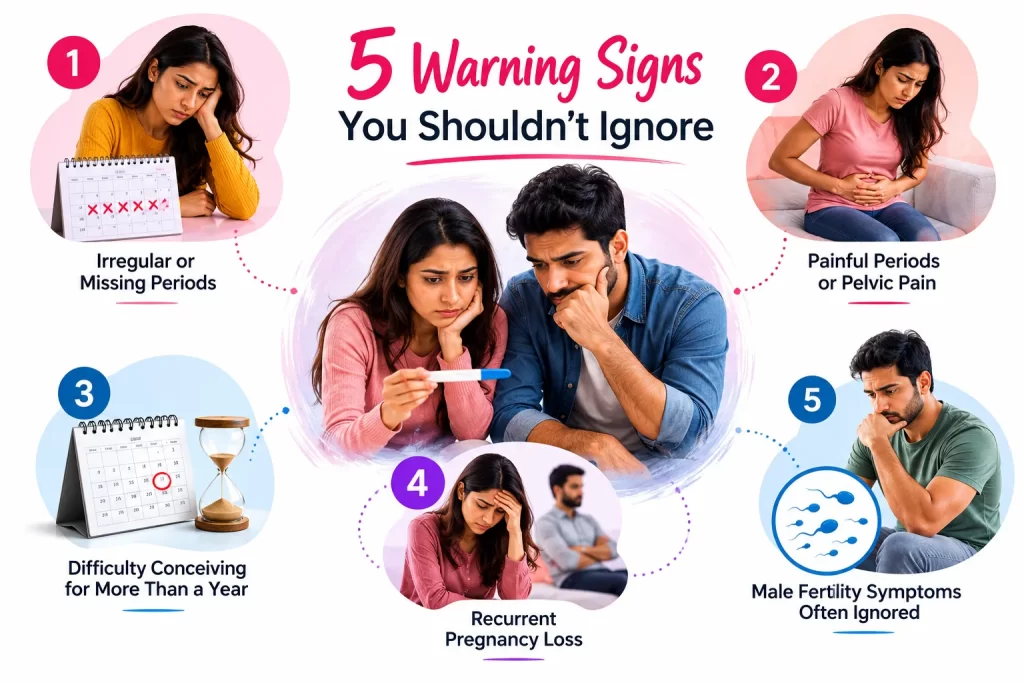
Some symptoms look small, but that gives you an early signs of infertility; you should not ignore it.
1. Irregular or Missing Periods
Your menstrual cycle can give a clue about your fertility health. When your period is irregular or missed, it could signify that your body does not release eggs regularly.
This could be caused by hormonal imbalance or even early signs of polycystic ovarian syndrome (PCOS), which can be a signs of female infertility.
2. Painful Periods or Pelvic Pain
Can you ignore your period pain as normal? But sometimes pelvic pain or painful periods can be a warning sign. It may be associated with other conditions, such as endometriosis, fibroids, or blocked fallopian tubes.
It may affect your reproductive system. Ignoring or failing to treat it in time may reduce your ability to conceive.
3. Difficulty Conceiving for More Than a Year
The American Society for Reproductive Medicine (ASRM) reported that about 80% of couples conceive within the first 6 months. Also, the majority conceive within 12 months of regular unprotected intercourse.
If you can not conceive within this time period, you may require medical help. Many couples choose to attend fertility awareness programs and free IVF camps to better understand their reproductive health and available treatment options.
4. Recurrent Pregnancy Loss
If you experience two or more pregnancy losses, called as recurrent miscarriage. It can happen if your egg quality is not good, you have any hormonal problems or some uterus-related problems.
5. Male Fertility Symptoms Often Ignored
It is important to know that men also have fertility problems. Common male infertility signs include low sperm count, poor sperm movement, or no sperm at all (azoospermia).
Tests for fertility include semen analysis and sperm DNA fragmentation, which may determine the reason behind infertility.
Age Matters: When to Act Sooner
Age is the most significant factor that affects fertility. With increasing age, fertility also undergoes several changes.
- Women aged over 35 years may experience reduced egg quality and quantity. Some women choose to learn about egg freezing when planning pregnancy for a later stage of life.
- On the other hand, for men, ageing may lead to poor sperm quality.
Nowadays, we see many couples in our clinic who face infertility due to delayed childbearing. It means they plan pregnancy later due to career, personal goals, or other responsibilities. Instead of delaying too much, you should go for early advice from Puja IVF Fertility Center in Patna to help you better understand your fertility health and available options.
What to Expect at Your First Consultation
Your first consultation regarding fertility is meant to understand your reproductive health. Fertility counselling helps us to assess your medical history, periods, and many other relevant aspects.
Knowing what information to carry and what questions to ask can make your first fertility consultation more productive.
Depending on your requirements, we advise you about some infertility tests in Patna, which include hormone tests, sonography of the pelvic area, HSG tests to examine the fallopian tubes, and semen analysis for men.
Who Is a Fertility Specialist? (OB/GYN vs Fertility Specialist)
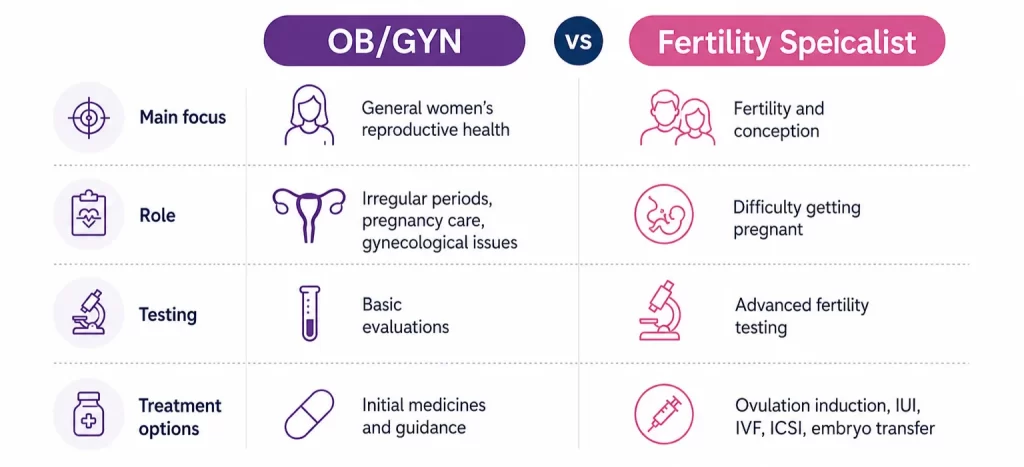
A fertility specialist is a doctor who helps when getting pregnant is difficult. But many couples are unsure of whether to see a gynecologist or a fertility specialist.
Both support your reproductive health. Let’s understand that their roles can be different depending on your needs.
| Concern | OB/GYN | Fertility Specialist |
| Main focus | General women’s reproductive health | Fertility and conception |
| Role | Irregular periods, pregnancy care, gynecological issues | Difficulty getting pregnant |
| Testing | Basic evaluations | Advanced fertility testing |
| Treatment options | Initial medicines and guidance | Ovulation induction, IUI, IVF, ICSI, embryo transfer |
If you are facing infertility, consulting with an IVF specialist in Patna can help you understand your fertility concerns and plan the right next steps.
How Lifestyle Affects Fertility in Bihar
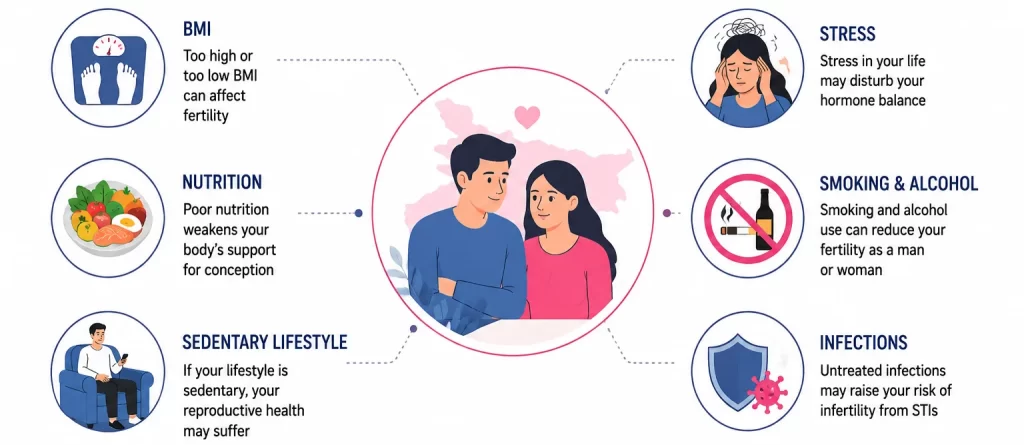
In Bihar, your daily habits can also affect fertility health. These factors may include:
- Your BMI, whether too high or too low, can affect your fertility
- Stress in your life may disturb your hormone balance
- Poor nutrition weakens your body’s support for conception
- Smoking and alcohol use can reduce your fertility as a man or woman
- If your lifestyle is sedentary, your reproductive health may suffer
- Untreated infections may raise your risk of infertility from STIs
Body weight is one of several factors that may influence reproductive outcomes and treatment success.
What Happens If You Wait Too Long?
Waiting too long before consulting with a fertility specialist can delay the discovery of fertility concerns. Such as:
- With age, your ovarian reserve may slowly reduce
- Existing conditions may also become harder to manage over time
- Delayed checks can affect treatment choices and may lower success rates
- Along with physical health, waiting for answers for a long time can bring emotional stress
- Also, you face an additional financial burden during fertility treatment
Taking the First Step Can Bring You Closer to Answers
The journey to parenthood does not always go as you planned. Fertility challenges can bring emotions and many questions, but you do not have to face them alone. Today, many infertility treatments in Patna are available to support couples.
If you notice warning signs, meeting experts like Dr Puja Kumari can give you answers and help you move forward with hope and confidence.
FAQs
1. How do I know if I need a fertility test?
You may benefit from fertility testing if you have been trying to conceive without success, have irregular periods, experience recurrent miscarriages, or have a known reproductive health condition. Fertility testing can help identify possible causes and guide further treatment decisions.
2. Does age affect male fertility?
Yes. Although men continue producing sperm throughout life, increasing age may affect sperm count, motility, DNA quality, and overall fertility potential. Age-related changes can also influence pregnancy outcomes.
3. Can infertility occur even if both partners appear healthy?
Yes. Some couples experience infertility despite normal test results and no obvious symptoms. This is often called unexplained infertility. In such cases, further evaluation and individualized treatment planning may be recommended.
4. Can being overweight affect fertility?
Yes. Excess body weight can affect hormone levels, ovulation, menstrual regularity, and sperm health. Achieving and maintaining a healthy weight may improve fertility in some individuals.
5. Can being underweight affect fertility?
Yes. Being significantly underweight may disrupt hormone production and ovulation, making conception more difficult. Proper nutrition and a healthy body weight are important for reproductive health.
6. Can infertility be treated without IVF?
Yes. Not all couples require IVF. Depending on the cause, treatment options may include lifestyle changes, medications, ovulation induction, treatment of underlying conditions, or IUI. The most appropriate treatment depends on individual fertility factors.