
Neha, a 29-year-old, came to our clinic with confusion and worry. She said, “Doctor, my pregnancy test was positive, but after some days, I had bleeding. Is it normal bleeding or something wrong? Was I really pregnant?” After carefully listening to her concerns, we advised her to take a blood test and an ultrasound. Her …


Neha, a 29-year-old, came to our clinic with confusion and worry. She said, “Doctor, my pregnancy test was positive, but after some days, I had bleeding. Is it normal bleeding or something wrong? Was I really pregnant?”
After carefully listening to her concerns, we advised her to take a blood test and an ultrasound. Her hCG level is reducing, and also in the ultrasound, we saw that there is no gestational sac (no visible sign of pregnancy). This condition is medically known as a biochemical pregnancy.
So, what exactly is a biochemical pregnancy, and why does it happen so early? If you’re planning treatment or unsure about your options, understanding the basics of IVF treatment can help you make informed decisions. Let’s understand this in detail.
Biochemical Pregnancy Meaning
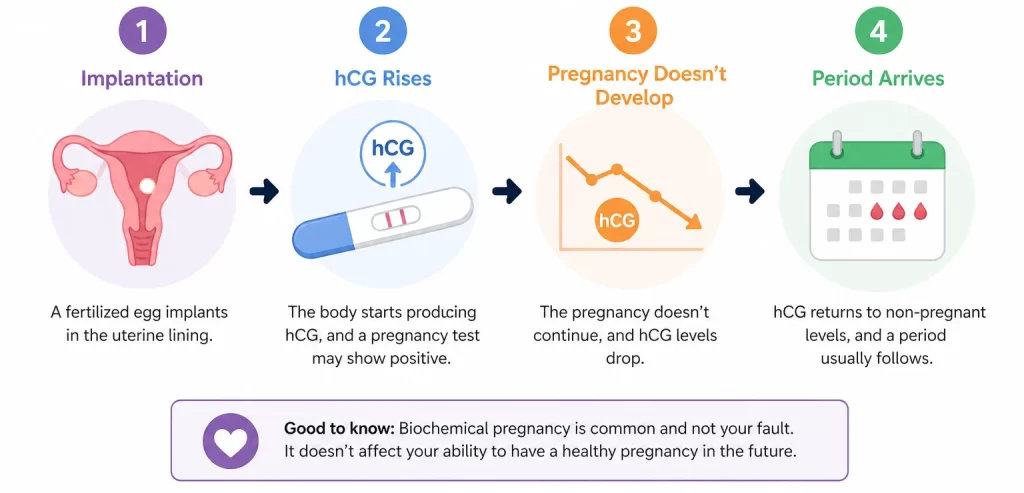
A biochemical pregnancy means a pregnancy loss that occurs before 5 weeks, also called early miscarriage. Since the pregnancy is detected only on a test, not on a scan, that’s why it is called a biochemical pregnancy.
This is quite common; about 50-75% early miscarriages happen very early, even before pregnancy is confirmed on an ultrasound. Many early pregnancy outcomes are better understood when you know the key factors affecting implantation and success, as explained in factors affecting IVF success rate.
But the question is, why did the pregnancy fail?
This happens because the fertilized egg forms and also begins to implant in your uterine lining, and your body starts producing hCG hormone. But after that, the embryo does not grow normally, and the pregnancy can not progress.
Biochemical Pregnancy vs Chemical Pregnancy
We saw that many patients are confused between biochemical and chemical pregnancy. So, both terms refer to early miscarriage before 5 weeks, but differ in how these terms are used.
In simple terms, “Biochemical pregnancy” is used in clinics by doctors, and “Chemical pregnancy” is used in general discussion and among patients.
If you’re comparing different fertility terms and treatments, this guide on IVF vs IUI treatment can give more clarity.
Biochemical Pregnancy Symptoms
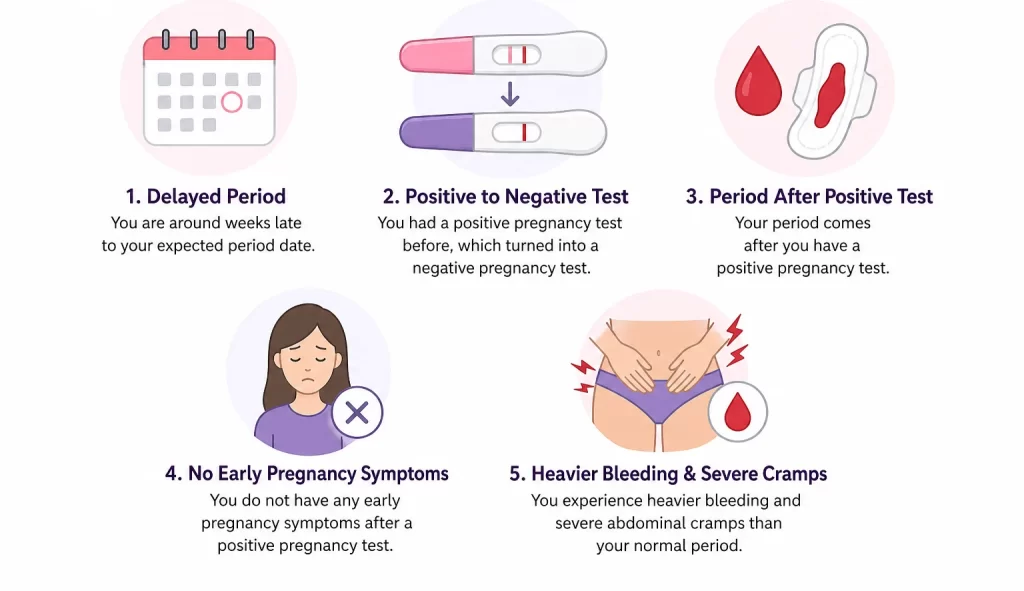
Biochemical pregnancy occurs early, so many women confuse it with their normal or delayed period. At this time, you have no signs, so it is hard to identify it.
However, you can notice the following biochemical pregnancy symptoms.
- You have a delayed period, around weeks late to the expected period date
- You had a positive pregnancy test before, which turned into a negative pregnancy test
- Your period comes after you have a positive test
- You do not have any early pregnancy symptoms after a positive pregnancy test
- You experience heavier bleeding and severe abdominal cramps than your normal period
Knowing how your body responds during early pregnancy is important, especially if you’re preparing for your first IVF consultation.
But how do we confirm a biochemical pregnancy? This is where monitoring your hCG levels becomes important for proper diagnosis.
Biochemical Pregnancy hCG Levels
Human chorionic gonadotropin, or hCG, is a pregnancy hormone that is produced after implantation.
As per the American Pregnancy Association, hCG is detected in a blood test after around 11 days, and in a urine test (home test), it is detected after 12 to 14 days when you conceive. Its levels double every 48-72 hours, indicating a healthy pregnancy progression.
In a biochemical pregnancy, your hCG levels rise initially, which gives you a positive test. But its levels may remain low (<100 mIU/mL) or fail to double properly and then decline, indicating that your pregnancy is not progressing.
Monitoring hormone levels is a key part of fertility treatment, especially during procedures like embryo transfer.
Biochemical Pregnancy Causes
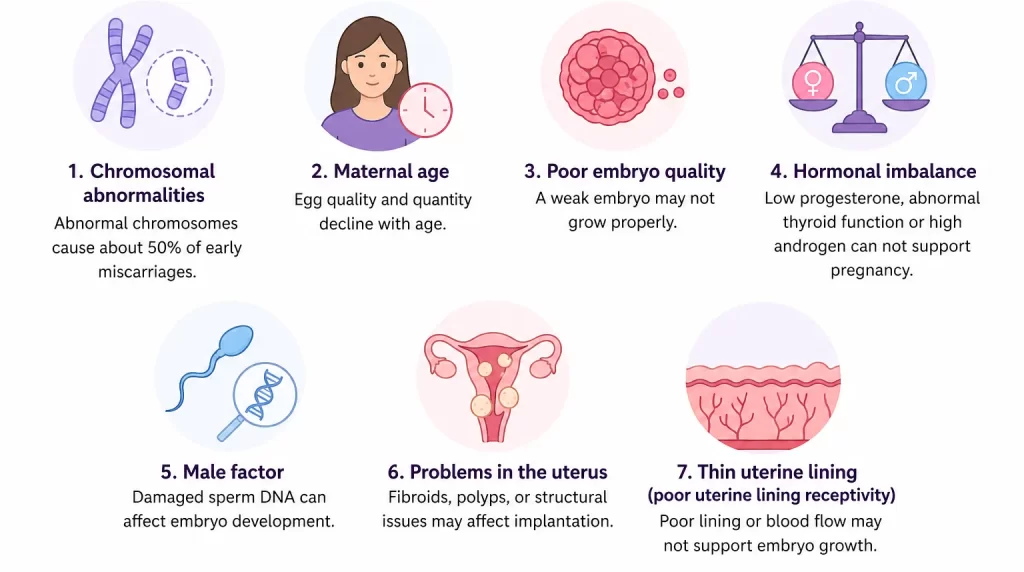
A Biochemical pregnancy causes arise when some factors interfere with when your embryo is growthing or during implantation that includes;
| Causes | What it means |
| Chromosomal abnormalities | Abnormal chromosomes cause about 50% of early miscarriages |
| Maternal age | Egg quality and quantity decline with age |
| Poor embryo quality | A weak embryo may not grow properly |
| Hormonal imbalance | Low progesterone, abnormal thyroid function or high androgen can not support pregnancy |
| Male factor | Damaged sperm DNA can affect embryo development |
| Problems in the uterus | Fibroids, polyps, or structural issues may affect implantation |
| Thin uterine lining (poor uterine lining receptivity) | Poor lining or blood flow may not support embryo growth |
Biochemical Pregnancy in IVF
The most common questions patients ask after IVF are, “I had a positive test after IVF, so why did my pregnancy not continue?”
For many patients, this moment brings both confusion and emotional stress.
In IVF, fertilization happens in a controlled lab. After we carefully select an embryo and transfer it into your uterus. When you get a positive test, that means implantation has occurred.
But what happens after implantation?
Research also shows that a 5-day embryo transfer may improve implantation success in some cases.
When we transfer an embryo, sometimes it does not develop further, and the pregnancy cannot continue. The causes are mostly the same as in a natural pregnancy.
However, Biochemical pregnancy is commonly detected early in IVF compared to a natural pregnancy because we closely monitor your hormone levels after embryo transfer.
Around 8–20% of of pregnancies in IVF were biochemical pregnancies.
So, let’s understand what happens next, and what care is needed after a biochemical pregnancy?
Biochemical Pregnancy Treatment & Next Steps
For a biochemical pregnancy, no specific medical care is required, because your body passes the pregnancy tissues naturally, similar to your normal period.
You may still need some basic care and follow-up during this time, such as:
- We advised you to do a follow-up blood test to ensure that your hCG hormone has declined to confirm that the pregnancy has ended.
- We also rule out fallopian tube pregnancy (ectopic pregnancy), which can be risky if missed.
- We give medication to manage pain or cramps to make you comfortable.
After this, our focus is on planning the next steps that help you achieve a healthy pregnancy. So, you can start try agin after one normal cycle.
If this happens repeatedly, we require a detailed evaluation to find the root cause. For this, we checked your hormone levels and assessed your uterine lining and uterus for any abnormalities.
In some situations, treatments like frozen embryo transfer may be considered in future cycles. In some cases, we advised couples to undergo genetic testing to detect any chromosomal abnormalities.
How to Prevent Biochemical Pregnancy
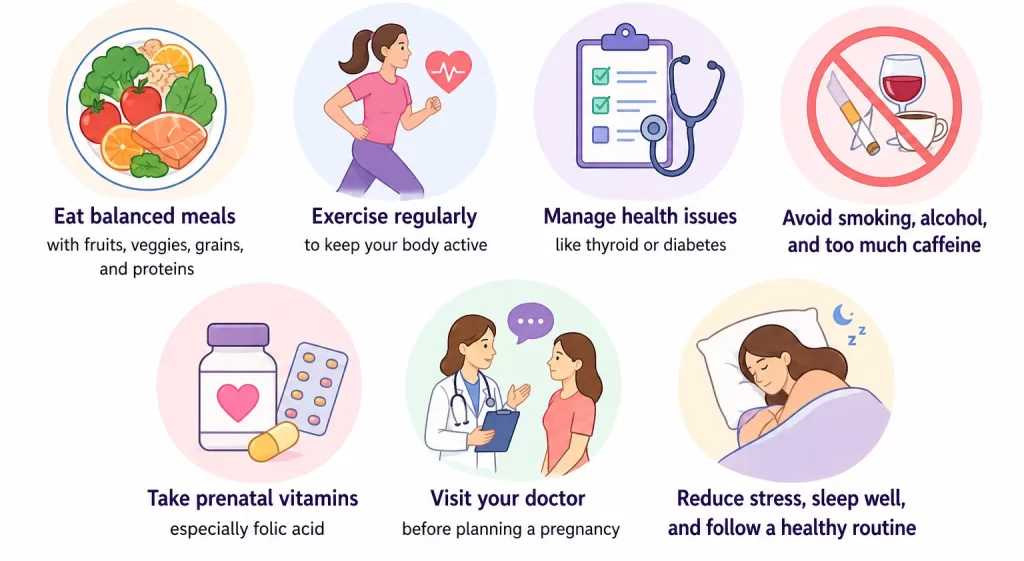
We can not prevent it, but we can reduce the risk by following some simple steps, such as;
- Eat balanced meals with fruits, veggies, grains, and proteins
- Exercise regularly to keep your body active
- Manage health issues like thyroid or diabetes
- Avoid smoking, alcohol, and too much caffeine
- Take prenatal vitamins, especially folic acid
- Visit your doctor before planning a pregnancy
- Reduce stress, sleep well, and follow a healthy routine
A healthy diet can also support fertility, and knowing the best foods during IVF treatment can be helpful.
Helping You Move Forward After Biochemical Pregnancy with Puja IVF

At Puja IVF Center in Patna, we identify the root cause through advanced testing and create a personalized plan for you. Our fertility specialist, Dr Puja Kumari, uses modern techniques to increase your success rates. Often, we choose day‑5 embryo transfer in IVF because stronger embryos may reduce early pregnancy loss.
If you’re exploring fertility treatments, understanding the cost of IVF in Patna can also help you plan better.
A biochemical pregnancy can feel hard and more common than you think. It does not define your fertility. It shows that your body has already started the process. With proper guidance and support, many women go on to achieve a healthy pregnancy.
FAQs
1. Is pregnancy possible after a biochemical pregnancy?
Yes, pregnancy is absolutely possible after a biochemical pregnancy. In fact, many women conceive successfully soon after. Ovulation can happen as early as two weeks after the bleeding, and this early loss usually does not affect your future fertility. Most women go on to have a healthy pregnancy.
2. How do you know if you had a biochemical pregnancy?
You may notice a positive pregnancy test followed by a negative test after a few days. Other signs include a delayed period, heavier-than-normal bleeding, and stronger cramps. Many women may not realize it and may mistake it for a late period.
3. Am I more fertile after a biochemical pregnancy?
Some studies suggest that fertility may temporarily improve after a biochemical pregnancy, especially within the first 2–3 months. This is because your body has already gone through fertilization and implantation, indicating that conception is possible.
4. What should I expect after a biochemical pregnancy?
You may experience bleeding similar to or slightly heavier than a normal period, along with mild to moderate cramps. Your hCG levels will gradually return to normal within 1–2 weeks. Most women recover physically quickly and can try again in the next cycle.
5. Is a biochemical pregnancy painful?
It can be slightly more painful than a normal period for some women. You may experience cramps and heavier bleeding, but the intensity varies. If pain is severe or unusual, it’s important to consult a doctor.
6. How soon can I try to get pregnant again?
You can try again as soon as you feel physically and emotionally ready. Ovulation may occur within two weeks after the loss. Some doctors suggest waiting for one normal cycle, but medically, it’s not always necessary.