
Have you ever thought that the IVF journey is full of numbers? Because it starts with your follicle counts, hormone levels, embryo grades, and, finally, the number of embryos to transfer into your uterus. So, what about the number of babies? If we transfer two embryos, does that mean you will have twins? Here, you …


Have you ever thought that the IVF journey is full of numbers? Because it starts with your follicle counts, hormone levels, embryo grades, and, finally, the number of embryos to transfer into your uterus.
So, what about the number of babies?
If we transfer two embryos, does that mean you will have twins?
Here, you may think, “Yes, two embryos mean two babies!”
No, this is not applicable in all cases. Yes, it is true that IVF has a higher chance of twins than natural pregnancy. But IVF is not a promise of twins. Behind every embryo transfer is a biological process that can lead to very different outcomes.
So, how does a twin pregnancy happen after IVF, and why are twins common with IVF? What determines the chances of twins with IVF?
Let us look at what the evidence and fertility specialists say.
Why Are Twins More Common with IVF?
During IVF, we give you ovarian stimulation medicines. This medicine helps develop more than one egg.
According to the American Society for Reproductive Medicine (ASRM), around 70% of mature eggs fertilise, and approximately 50% of those fertilised eggs continue developing into blastocysts.
This is why we aim to retrieve multiple eggs. After being fertilised in the laboratory, we transfer one or two embryos. If both embryos implant successfully, twins can develop. Sometimes, a single embryo may split into two, resulting in twins.
What Are the Chances of Twins with IVF?
There is no fixed percentage of twins born from IVF for all patients.
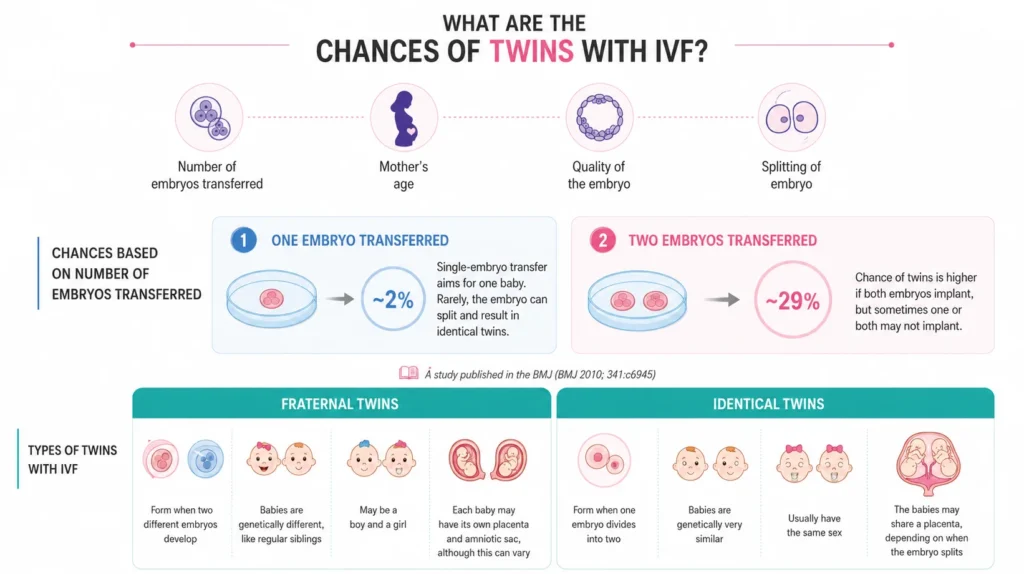
The chances of having twins with IVF may vary depending on the following factors:
- Number of embryos transferred
- Mother’s age
- Quality of the embryo
- Splitting of embryo
The number of embryos transferred is only one part of the treatment decision, as several other factors affecting IVF success may also influence the outcome.
Here is what the study says about chances based on the number of embryos transferred:
- One embryo transferred:
In a single-embryo transfer, we place one embryo into your uterus, usually with the aim of achieving a singleton pregnancy. Rarely, that embryo can split during early development and result in identical twins.
- Two embryos transferred:
In a double-embryo transfer, two embryos are placed in your uterus. The chance of twins with IVF 2 embryos is higher when both embryos successfully implant. But it does not always lead to twins; sometimes one or both may fail to implant.
A study published in the BMJ compared the chances of twins after transferring one versus two embryos. With one embryo, the twin or multiple-birth rate was about 2%, while with two embryos, it was about 29% among pregnancies resulting in a live birth.
The table below shows the difference between fraternal vs identical twins with IVF:
| Fraternal Twins | Identical Twins |
| Form when two different embryos develop | Form when one embryo divides into two |
| Babies are genetically different, like regular siblings | Babies are genetically very similar |
| May be a boy and a girl | Usually have the same sex |
| Each baby may have its own placenta and amniotic sac, although this can vary | The babies may share a placenta, depending on when the embryo splits |
Can You Choose to Have Twins with IVF?
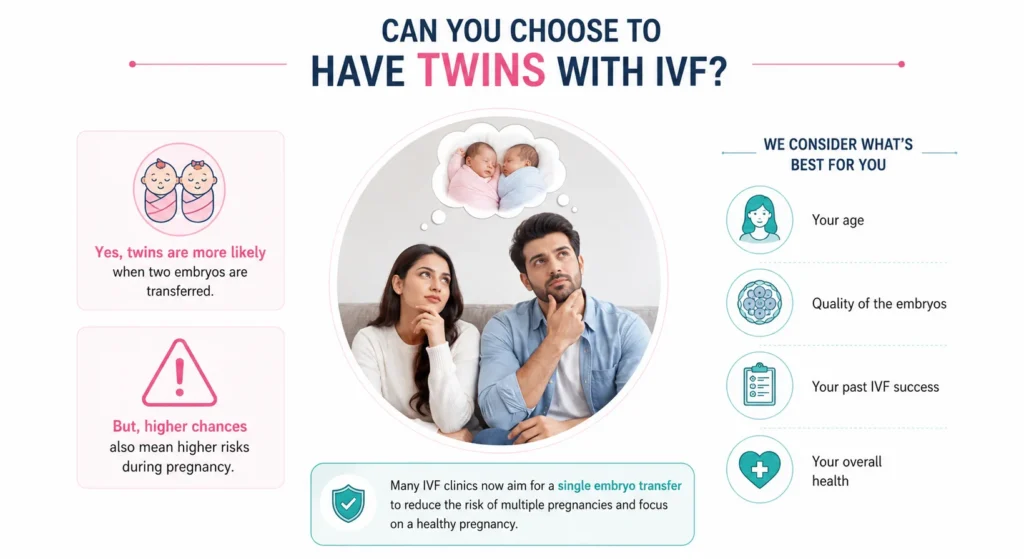
“Doctor, can we choose to have twins?”
This is a question some couples ask us when planning IVF, especially after hearing that transferring two embryos may result in twins. Transferring more than one embryo raises the chance of twins, but also increases the risk of complications that may arise during the pregnancy.
Before embryo transfer, we may consider your age, the quality of the embryos, your past history of IVF success, and your overall general health. Depending on your treatment plan, the decision about embryo transfer may also involve choosing between a fresh vs frozen embryo transfer. Also, nowadays many IVF clinics aim for single embryo transfer; this helps reduce the risk of higher-order multiple pregnancies while maintaining a focus on a healthy pregnancy.
Risks of Twin Pregnancy with IVF
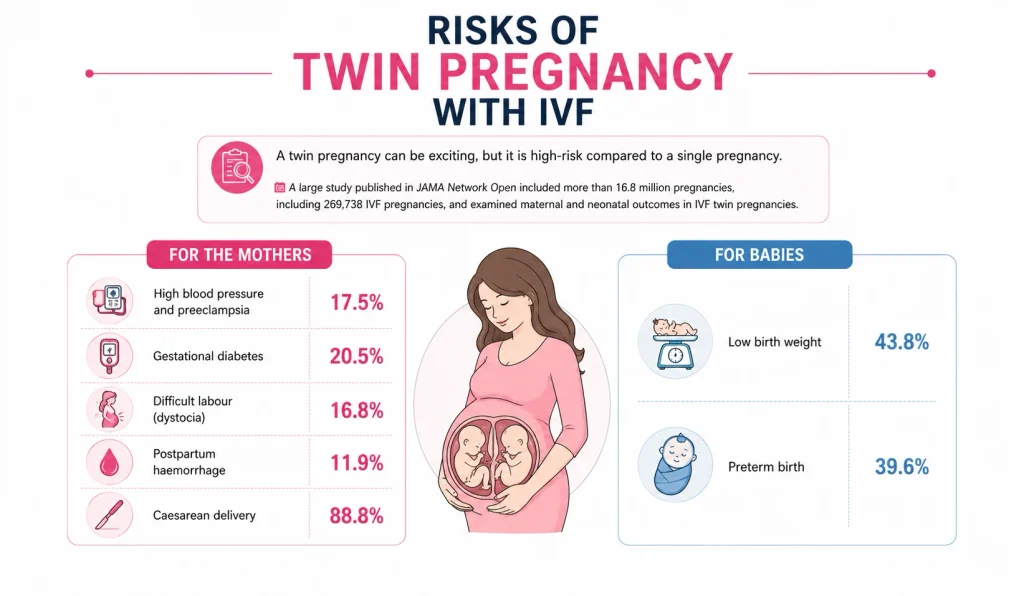
A twin pregnancy can be very exciting, but it is high-risk compared to a single pregnancy.
A large study published in JAMA Network Open included more than 16.8 million pregnancies, including 269,738 IVF pregnancies, and examined maternal and neonatal outcomes in IVF twin pregnancies.
The study reported these outcomes:
| For the mothers | High blood pressure and preeclampsia | 17.5% |
| Gestational diabetes | 20.5% | |
| Difficult labour (dystocia) | 16.8% | |
| Postpartum haemorrhage | 11.9% | |
| Caesarean delivery | 88.8% | |
| For babies | Low birth weight | 43.8% |
| Preterm birth | 39.6% |
Signs & Symptoms of a Twin Pregnancy After IVF
Some women pregnant with twins may feel that their early pregnancy symptoms are more noticeable, but every pregnancy is different.
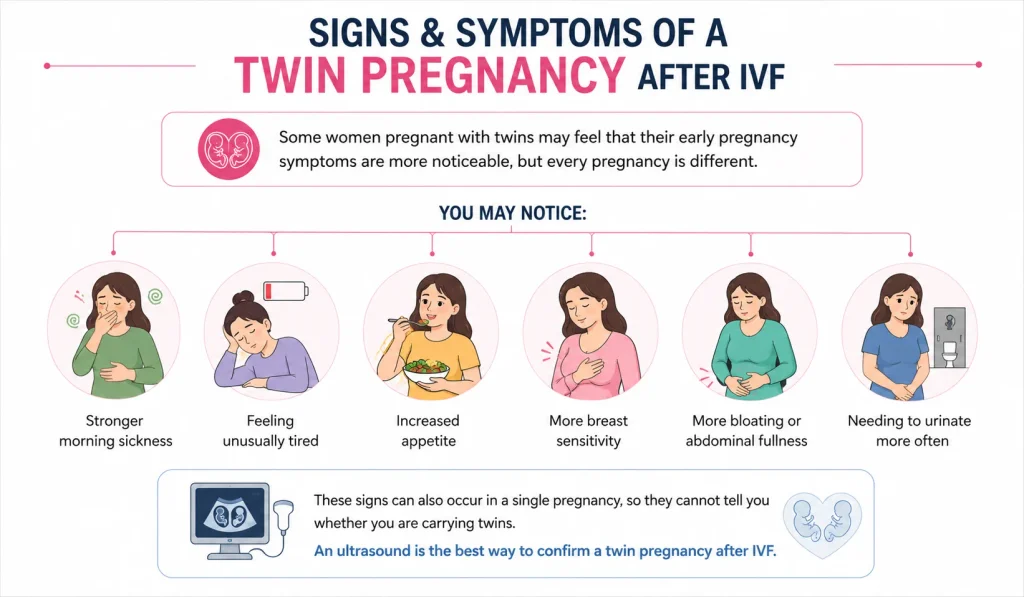
You may notice:
- Stronger morning sickness
- Feeling unusually tired
- Increased appetite
- More breast sensitivity
- More bloating or abdominal fullness
- Needing to urinate more often
These signs can also occur in a single pregnancy, so they cannot tell you whether you are carrying twins. An ultrasound is the best way to confirm a twin pregnancy after IVF.
Common Questions Patients Ask
Here are some of the most common questions that our patients raise concerning the possibility of twins with IVF and corresponding answers:
- Can I Have Twins with IVF?
Yes, it is possible to give birth to twins after undergoing IVF, although the outcome cannot be determined in advance. Every cycle of treatment is unique, and your chances may depend on your IVF plan and history.
- What Percentage of IVF Pregnancies Are Twins?
Approximately 30% of pregnancies conceived through IVF can be classified as twin pregnancies, while the rate of twins being conceived through natural conception is only 1 to 2%.
- Are Twin Pregnancies After IVF Monitored Differently?
Yes, there are a number of differences in the monitoring of a twin pregnancy as compared to that of a single pregnancy. This is because twin pregnancies are more susceptible to certain complications.
Talk to Your Fertility Specialist
Before embryo transfer, talk to your fertility specialist about:
- The best transfer option for you
- Your embryo development
- Possible pregnancy outcomes
- Your concerns about twins
- Any risks linked to multiple pregnancy
After the procedure, following appropriate precautions after embryo transfer may also help you understand what to expect during the early days of the waiting period.
It is also useful to understand the dos and don’ts after IVF embryo transfer while waiting to find out whether the embryo has implanted.
Understanding these points can help you make an informed decision for a healthy pregnancy. Patients planning treatment may also want to understand how the IVF cost in Patna can vary depending on the treatment plan and procedures involved.
Why Choose Puja IVF for Embryo Transfer in Patna

At Puja IVF Center in Patna, Dr Puja Kumari focuses on helping patients understand what happens at each stage of embryo transfer. We discuss your concerns, explain the available options and answer questions about twins and multiple pregnancies, so you can approach your IVF treatment with greater clarity and confidence.
Conclusion
Twins can be part of an IVF journey, but they should never be the only goal. Every treatment is different. Understanding your options and discussing embryo-transfer choices with your fertility specialist can help you make informed decisions while keeping your health and your baby’s wellbeing first.
FAQs
1. Is it easy to get twins with IVF?
IVF can increase the chances of twins, particularly when more than one embryo is transferred and both embryos implant successfully. However, twins are not guaranteed. With a single embryo transfer, the chance of twins is generally low, although one embryo can rarely split and result in identical twins.
2. What is the risk of having twins with IVF?
The risk of twins depends mainly on the number of embryos transferred, along with factors such as age, embryo quality, and whether an embryo splits. Transferring two embryos generally carries a higher chance of twins than transferring one embryo.
3. Can I ask for twins in IVF?
You can discuss your preference and concerns about twins with your fertility specialist, but IVF treatment is planned based on medical factors rather than simply choosing a twin pregnancy. Transferring more than one embryo can increase the chance of twins, but it also increases the risk of complications for both the mother and babies.
4. Are IVF babies mostly twins?
No. IVF does not usually result in twins. Many modern IVF clinics aim for a single embryo transfer to reduce the chance of multiple pregnancy and its associated risks. A singleton pregnancy is generally the intended outcome for many IVF treatments.
5. Are IVF twin pregnancies monitored differently?
Yes. Twin pregnancies are generally considered higher-risk than singleton pregnancies and may require closer monitoring. Doctors may pay particular attention to complications such as high blood pressure, gestational diabetes, preterm birth, and low birth weight.
6. At what stage are twins detected after IVF?
Twins are usually confirmed through an early pregnancy ultrasound after IVF. The exact timing can vary depending on the treatment plan and the doctor’s recommendation. An ultrasound can show whether one or more gestational sacs and developing embryos are present.