
Recently, I met Disha, a 32-year-old, who had been trying for one year. She is concerned, “ Doctor, my periods are regular, so why am I not getting pregnant?” As part of the fertility evaluation, we advised her to do a fertility test to know about her reproductive health. If you're unsure about the right …

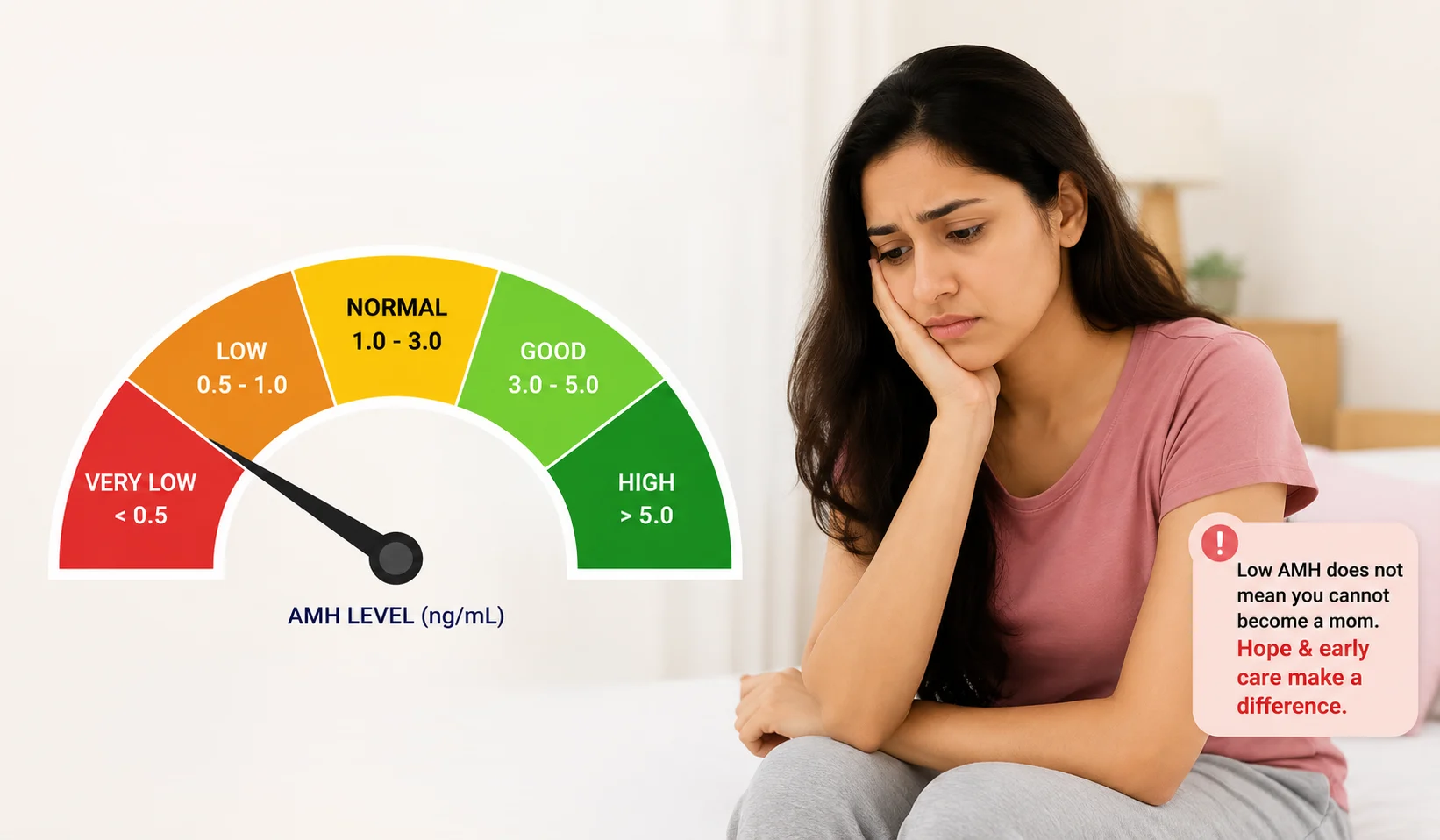
Recently, I met Disha, a 32-year-old, who had been trying for one year. She is concerned, “ Doctor, my periods are regular, so why am I not getting pregnant?”
As part of the fertility evaluation, we advised her to do a fertility test to know about her reproductive health. If you’re unsure about the right time to seek medical advice, our guide on when to see a fertility specialist explains the signs that indicate it’s time for a fertility evaluation.
Her report showed that she had a low AMH level. She became anxious and thought, “Does this mean I can never become a mother with my own eggs?”
There are many women who experience the same fear after receiving a low AMH report and worrying about their low AMH pregnancy chances. It is important to understand that your fertility is not defined by a single number.
In this guide, we talk about what low AMH actually means, how it affects fertility, and what treatment options are available to help you make informed decisions and move forward with hope.
What Is AMH and Why Is It Important for Fertility?
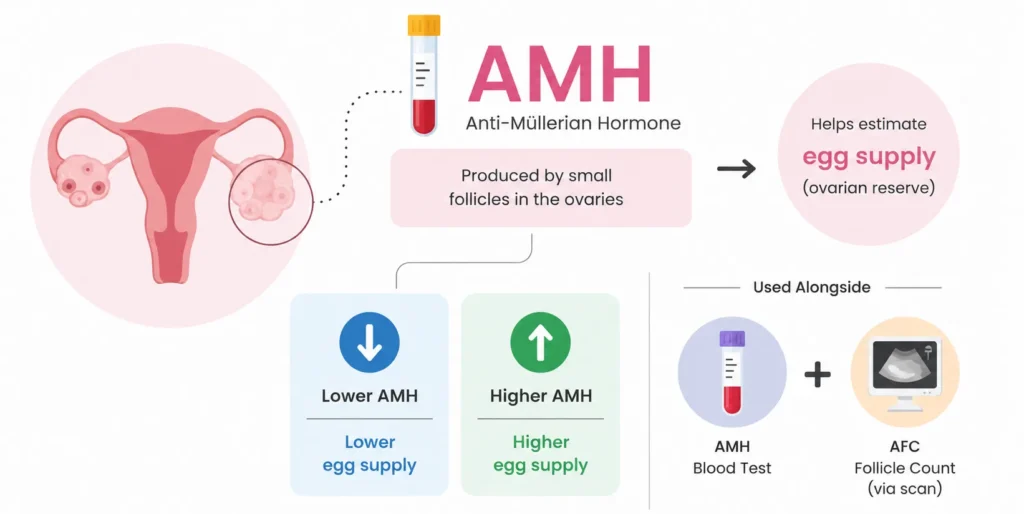
Anti-Müllerian Hormone, or AMH, is a hormone that is produced by a small follicle present in your ovaries. This AMH test is important in fertility because it helps us estimate your egg supply, or ovarian reserve.
- A lower AMH level may indicate a lower egg supply
- A higher level may suggest a higher ovarian reserve
We typically use AMH alongside AFC. But many patients are confused between these two terms. So, both tests give information about your ovarian reserve. AMH is a blood test, and AFC is antral follicle count, which means we count your follicles through a scan to understand your ovarian reserve.
Along with AMH, hormone levels such as estrogen also influence fertility, and understanding high estrogen in females can provide a more complete picture of reproductive health.
AMH Normal Range – What Is a Good AMH Level to Get Pregnant?
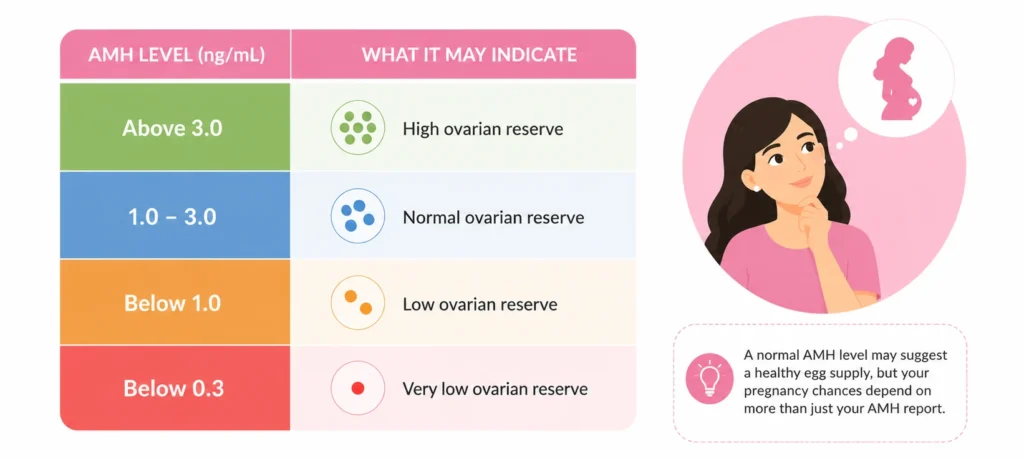
AMH level can vary from woman to woman. Also, no single AMH value guarantees pregnancy.
The table below shows the AMH ranges commonly used during fertility evaluation:
| AMH Level (ng/mL) | What It May Indicate |
| Above 3.0 | High ovarian reserve |
| 1.0-3.0 | Normal ovarian reserve |
| Below 1.0 | Low ovarian reserve |
| Below 0.3 | Very low ovarian reserve |
But what is a good AMH level to get pregnant? A normal AMH level may suggest a healthy egg supply, but your chances of pregnancy depend on more than just your AMH report.
Does Low AMH Mean You Cannot Get Pregnant?
No, a low AMH level does not mean that you cannot get pregnant. To achieve pregnancy, you only need one healthy egg.
Also, there are several factors that affect pregnancy, including your age, the quality of your eggs, sperm quality, and your reproductive health status as well. Many of these same factors also influence IVF outcomes and success rate. Several women with low AMH levels continue to ovulate and get pregnant successfully.
A study published in the European Journal of Obstetrics & Gynaecology and Reproductive Biology found that women aged 30-44 years with low AMH levels had similar chances of natural conception compared with women who had normal AMH levels.
Low AMH but Regular Periods – What Does It Mean?
It makes many women quite confused to have low AMH yet still have normal menstrual cycles. A low AMH level with regular periods means your ovaries have a low number of eggs, but your eggs are maturing and releasing in each month.
So, AMH level and regular period are not connected. In simple terms, a regular period indicates that your ovaries are still working, while AMH indicates the remaining egg supply in your ovaries.
Does Age Matter More Than AMH?
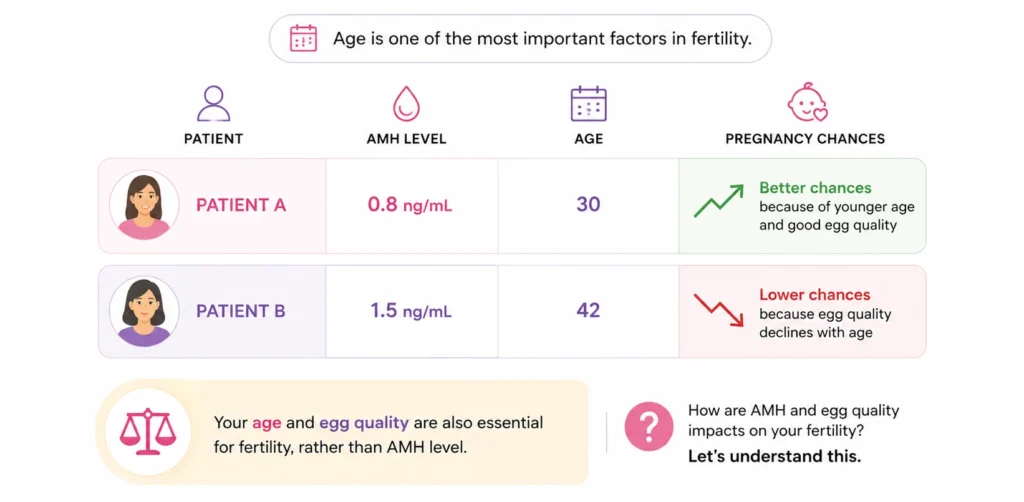
Yes. Age is definitely one of the most significant parameters in fertility, more than AMH value.
In our clinic, we have seen women with different AMH levels and ages.
| Patient | AMH Level | Age | Pregnancy Chances |
| Patient A | 0.8 ng/mL | 30 | Better chances because of younger age and good egg quality |
| Patient B | 1.5 ng/mL | 42 | Lower chances because egg quality declines with age |
This highlights that your age and egg quality are also essential for fertility, rather than AMH level.
But how are AMH and egg quality impacts on your fertility? Are AMH and egg quality the same? Let’s understand this.
Low AMH and Egg Quality – Are They the Same?
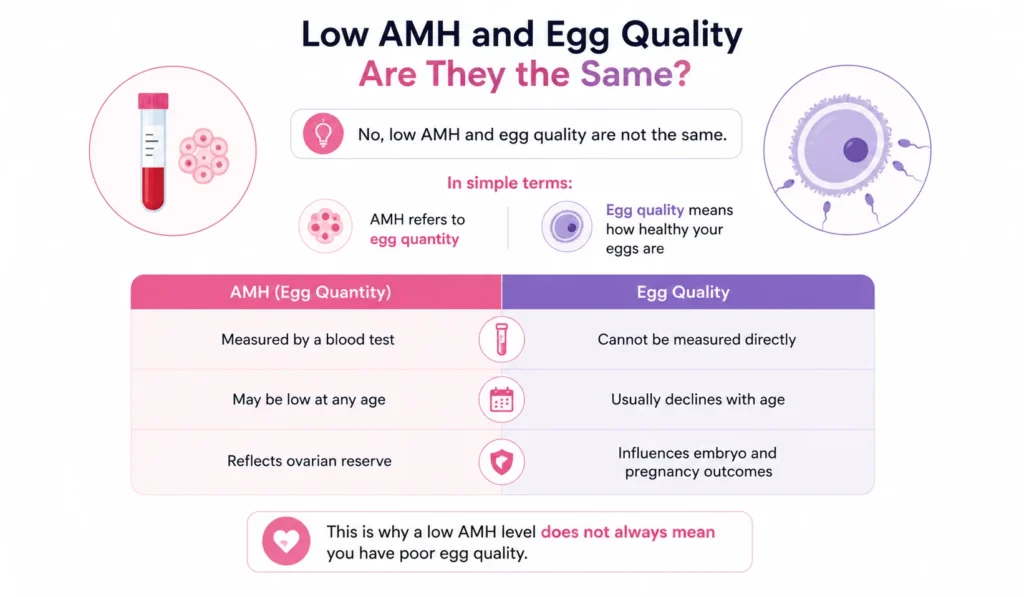
No, low AMH and egg quality are not the same.
In simple terms;
- AMH refers to egg quantity
- Egg quality means how healthy your eggs are
Here is a simple comparison of the AMH and egg quality:
| AMH (Egg Quantity) | Egg Quality |
| Measured by a blood test | Cannot be measured directly |
| May be low at any age | Usually declines with age |
| Reflects ovarian reserve | Influences embryo and pregnancy outcomes |
This is why a low AMH level does not always mean you have poor egg quality.
IVF with Low AMH – Can IVF Still Work?
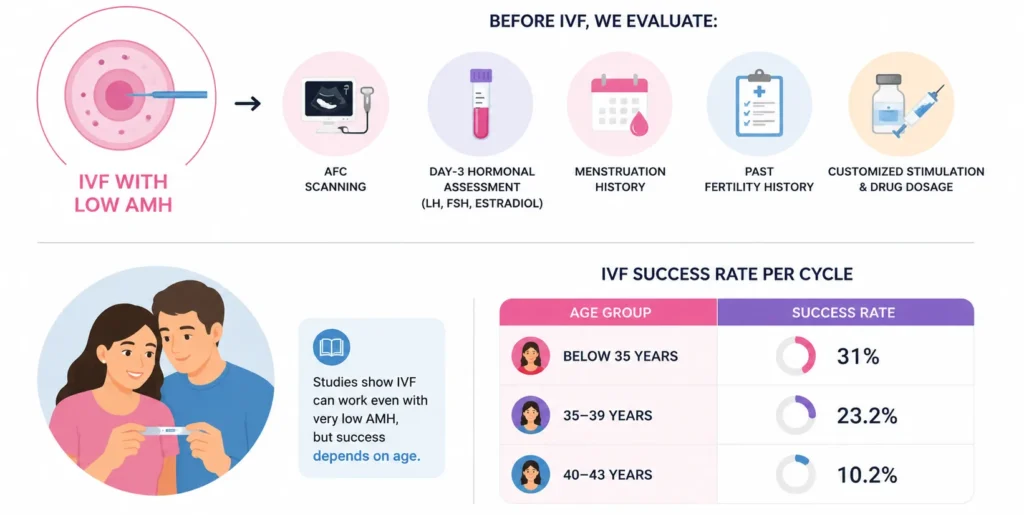
Yes. IVF with low AMH can still work. IVF may be the most effective procedure if you want to conceive with your own eggs. If you’re new to the procedure, this complete guide to IVF treatment explains every step, from evaluation to embryo transfer.
Before starting the process of IVF treatment, we do an evaluation of the following to analyse your fertility status:
- AFC scanning
- Day-3 hormonal assessment for LH, FSH, and estradiol
- Your history of menstruation
- Past fertility history
Based on this, we choose the best ovarian stimulation protocol and modify the drug dosage to make sure your ovaries respond to the IVF treatment.
A study in the Journal of Assisted Reproduction and Genetics claims that, having a very low level of AMH, it is possible to conceive through IVF, but success depends on age.
| Age Group | IVF success rate per cycle |
| Below 35 years | 31% |
| 35-39 years | 23.2% |
| 40-43 years | 10.2% |
Couples who are planning treatment also often want to understand the IVF cost in Patna before beginning their fertility journey.
What Is the Best Fertility Treatment for Low AMH?
There is no one perfect fertility treatment for women with low AMH.
We mostly recommend the following treatment for low AMH:
- Ovulation induction
- Intrauterine insemination (IUI)
- IVF treatment
- Fertility preservation, such as egg freezing or embryo freezing, in selected cases
If IUI is recommended, understanding the IUI treatment procedure, safety and success rate can help you know what to expect.
The right low AMH treatment approach depends on your age, ovarian reserve, and fertility goals. If you’re comparing treatment options, understanding the differences between IVF vs IUI treatment can help you make a more informed decision.
How to Improve Your Chances of Pregnancy with Low AMH
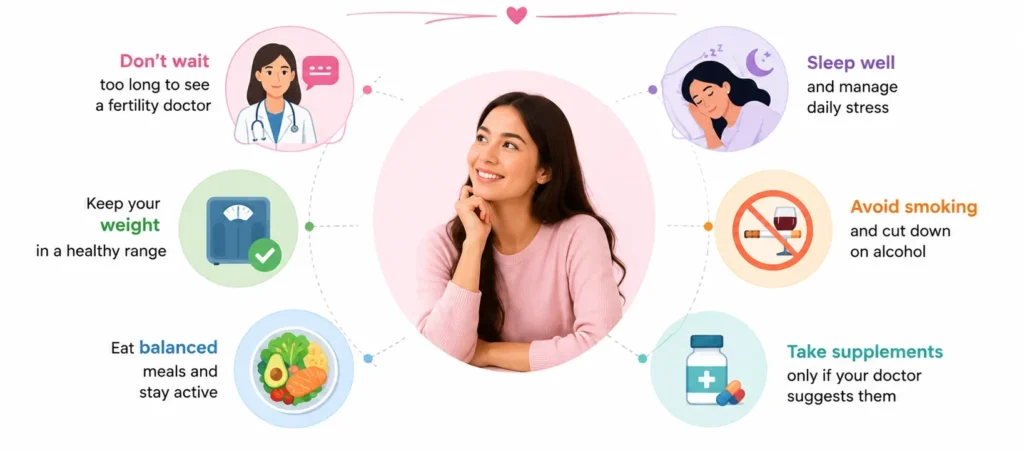
You can not increase your AMH level, but by following simple steps, you can improve your chances of pregnancy:
- Don’t wait too long to see a fertility doctor
- Keep your weight in a healthy range
- Eat balanced meals and stay active
- Sleep well and manage daily stress
- Avoid smoking and cut down on alcohol
- Take supplements only if your doctor suggests them
Choosing the best foods to eat during IVF treatment may also support your overall reproductive health during the fertility journey.
Final Thoughts: Your Fertility Is More Than an AMH Number

A low AMH level is only one part of your fertility journey. Age, egg quality, overall reproductive health, and timely treatment also play an important role. At Puja IVF Center, Patna, Dr Puja Kumari and her team focus on understanding each woman’s individual needs and fertility goals. With the right guidance and treatment, many women with low AMH can still achieve pregnancy.
FAQs
1. What is the main cause of low AMH?
The most common cause is natural ageing, as ovarian reserve gradually declines over time. Other possible causes include previous ovarian surgery, certain medical treatments such as chemotherapy, genetic factors, autoimmune conditions, and premature ovarian insufficiency. A fertility evaluation helps identify the underlying cause.
2. Can supplements increase AMH levels?
Currently, there is no scientifically proven supplement that can significantly increase AMH levels. Some supplements may support overall reproductive health or egg quality in selected women, but they should only be taken under the guidance of a fertility specialist. Self-medicating is not recommended.
3. Should I worry if my AMH is below 0.5 ng/mL?
An AMH level below 0.5 ng/mL suggests a very low ovarian reserve, but it does not mean pregnancy is impossible. Many women with very low AMH have conceived naturally or through IVF. Your age, egg quality, AFC, and overall reproductive health are equally important in determining your chances of pregnancy.
4. What are the symptoms of low AMH?
Low AMH itself usually does not cause noticeable symptoms. Many women discover they have low AMH only after fertility testing. Some women may experience difficulty conceiving or shorter menstrual cycles if low AMH is associated with diminished ovarian reserve, but regular periods can still occur.
5. Can PCOS affect AMH levels?
Yes. Women with polycystic ovary syndrome (PCOS) often have higher-than-normal AMH levels because they have a larger number of small ovarian follicles. A high AMH level alone does not necessarily indicate better fertility, so doctors interpret AMH results together with ultrasound findings and hormone tests.
6. Can low AMH be inherited?
Yes. Genetics can influence ovarian reserve. If your mother or sisters experienced early menopause or diminished ovarian reserve, you may also have a higher chance of developing low AMH at a younger age.