
After weeks of injections, scans, and waiting, you finally reach the stage that you have been hoping for: the embryo transfer. It is the moment when you feel one step closer to holding your baby. But this stage also brings an important question: "Is your body ready for embryo transfer now, or would waiting for …

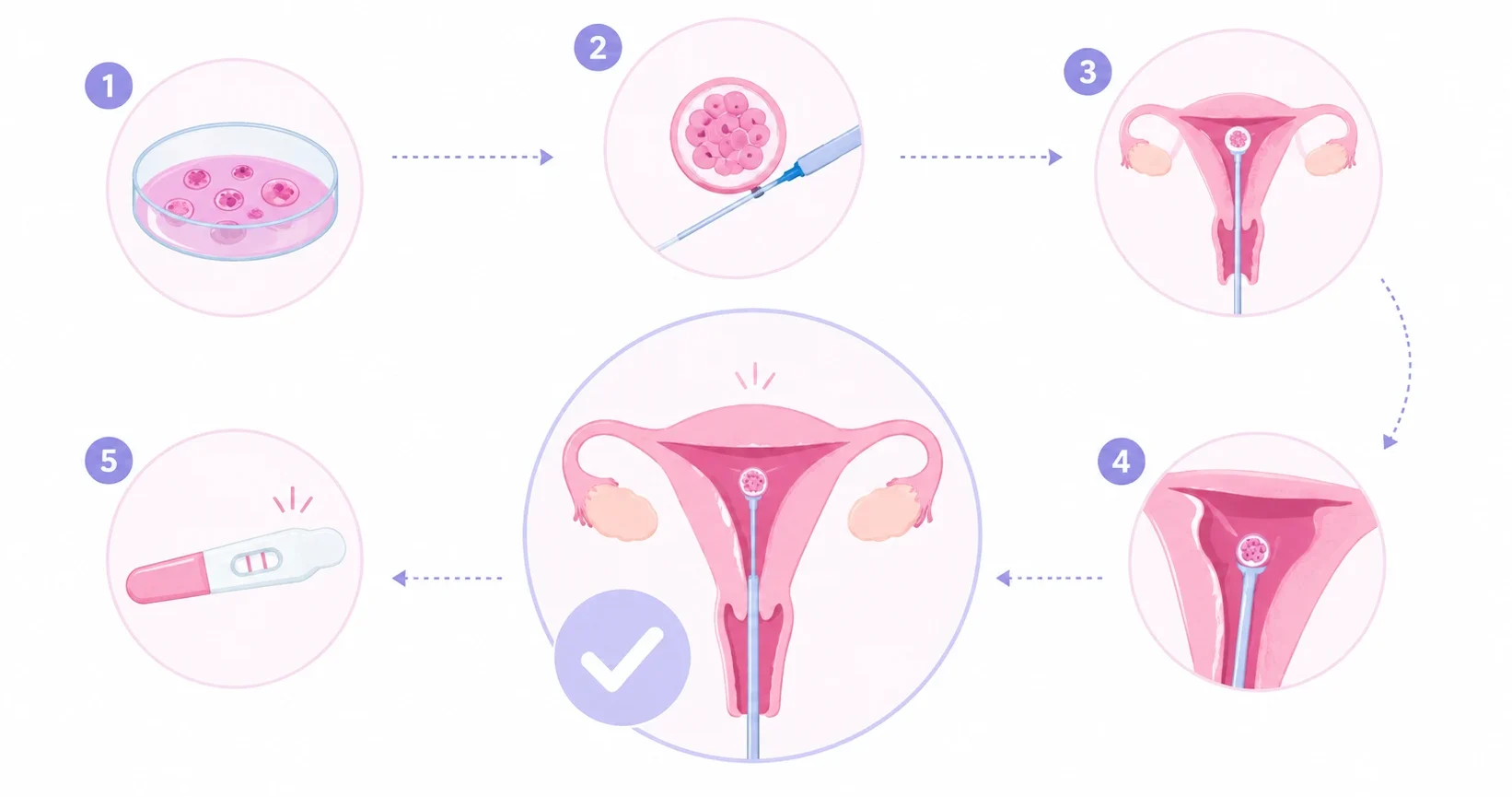
After weeks of injections, scans, and waiting, you finally reach the stage that you have been hoping for: the embryo transfer. It is the moment when you feel one step closer to holding your baby.
But this stage also brings an important question: “Is your body ready for embryo transfer now, or would waiting for some period give a better chance?”
As fertility specialists, we believe that successful IVF not only depends on creating a healthy embryo. It is also about placing it at the right time. Depending on your situation, we advise you to choose either a fresh or a frozen embryo transfer.
If you’re beginning fertility treatment, it may also help to understand the difference between IUI, IVF and ICSI before comparing embryo transfer options.
Each method has its own advantages and can support IVF success rates in different ways. In this guide, we explain the difference between fresh vs frozen embryo transfer to help you feel more confident in your IVF journey.
Understanding Embryo Transfer in IVF
Embryo transfer is the final step in the IVF procedure. In our laboratory, we collect the eggs from you as well as your partner’s sperm and fertilize them in our laboratory.
Depending on your fertility diagnosis, fertilization may be performed using conventional IVF or ICSI (Intracytoplasmic Sperm Injection).
After the embryos are ready, the next important step is the timing of the transfer procedure. But before this, our decision about timing depends on the following factors:
- We evaluate your uterine lining thickness and ensure it is ready for implantation or not
- We check whether your hormone levels are suitable after egg retrieval
- Whether your ovaries have responded too strongly to fertility medications (OHSS)
- How your body responds to medication for fertility treatment
Hormone balance plays an important role during IVF, and unusually high estrogen levels can sometimes influence treatment planning. Based on the above factors, embryo transfer may be either fresh or frozen. But which is better, fresh or frozen embryo transfer?
Let’s understand the difference between these two approaches to answer this question.
What Is a Fresh Embryo Transfer?
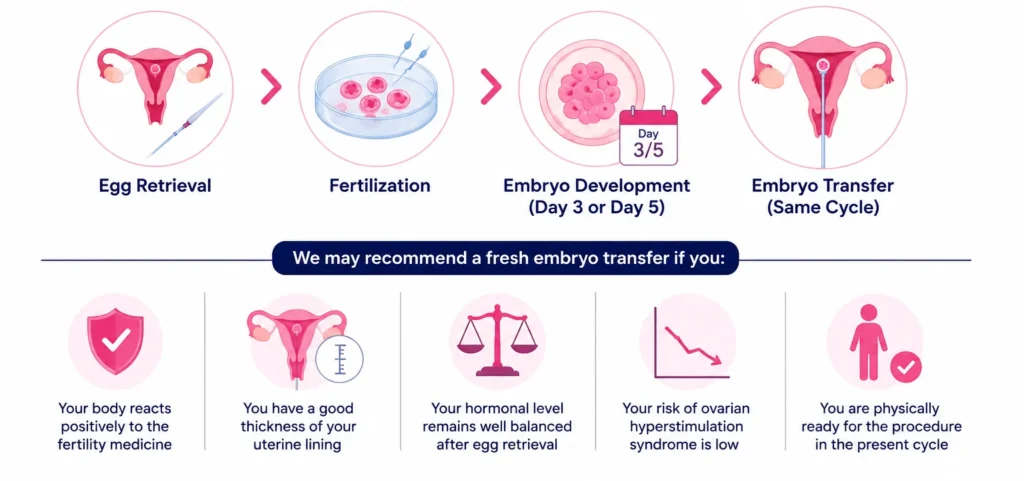
Fresh embryo transfer means embryos that are retrieved and fertilized in an IVF cycle are transferred to your uterus in the same cycle.
, depending on how your embryo develops.
If your embryo reaches the blastocyst stage, your fertility specialist may recommend a blastocyst transfer based on its development.
We may recommend a fresh embryo transfer if you:
- Your body reacts positively to the fertility medicine
- You have a good thickness of your uterine lining
- Your hormonal level remains well balanced after the egg retrieval process
- Your risk of having ovarian hyperstimulation syndrome is low
- You are physically ready for the procedure in the present cycle
Following a healthy lifestyle and eating the best foods to eat during IVF treatment may also help support your body during the IVF cycle.
What Is a Frozen Embryo Transfer (FET)?
Frozen embryo transfer (FET) means your embryos are frozen and stored in our laboratory for future use. This method is referred to as cryopreservation. Your embryos are preserved in liquid nitrogen until embryo transfer is scheduled.
Freezing embryos is one of the approaches used in fertility preservation for people who wish to plan pregnancy in the future.
Before transfer, we can prepare your body for frozen embryo transfer as follows:
- Estrogen medication is administered to you; it may be used to thicken your uterine lining.
- An ultrasound scan is done to see whether there is sufficient thickness of your uterine lining, around 7-8 mm.
- Once the thickness is reached, we start giving you progesterone medication to prepare it for embryo implantation.
When you are ready for embryo transfer, we first thaw your embryo and gently transfer it into your uterus.
Fresh vs Frozen Embryo Transfer Success Rates
Many couples have questions: “Which has a higher success rate, fresh or frozen embryo transfer?”
It is important to understand that both embryo transfers result in successful pregnancies. But the success rate is not the same for every patient.
Several factors influence IVF outcomes, including age, embryo quality, uterine health, and hormonal balance, which are discussed in our guide on factors affecting IVF success rate.
A large study comparing fresh vs frozen embryo transfer success rates found that frozen embryo transfer was associated with better outcomes in some patients.
The table below highlights the main findings.
| Outcome | Fresh Embryo Transfer | Frozen Embryo Transfer |
| Chance of having a baby (Live birth rate) | 39.8% | 48.3% |
| Overall treatment success | 60.0% | 74.0% |
However, a recent 2025 study suggests that fresh embryo transfer may provide better outcomes for some women with low ovarian reserve or a poor response to IVF treatment.
This shows that there is no single approach that is suitable for every patient, and the choice between fresh and frozen embryo transfer should always be individualized.
Advantages of Frozen Embryo Transfer
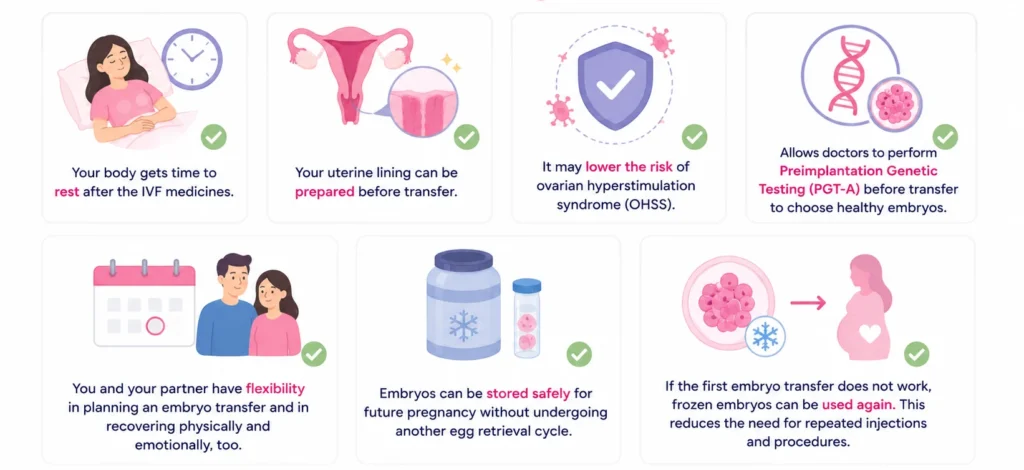
Frozen embryo transfer has many benefits, which include:
- Your body gets time to rest after the IVF medicines.
- Your uterine lining can be prepared before transfer.
- It may lower the risk of ovarian hyperstimulation syndrome (OHSS)
- Allows doctors to perform Perimplantation Genetic Testing (PGT‑A) before transfer to choose healthy embryos.
- You and your partner have flexibility in planning an embryo transfer and in recovering physically and emotionally, too.
- Embryos can be stored safely for future pregnancy without undergoing another egg retrieval cycle.
- If the first embryo transfer does not work, frozen embryos can be used again. This reduces the need for repeated injections and procedures.
Advantages of Fresh Embryo Transfer
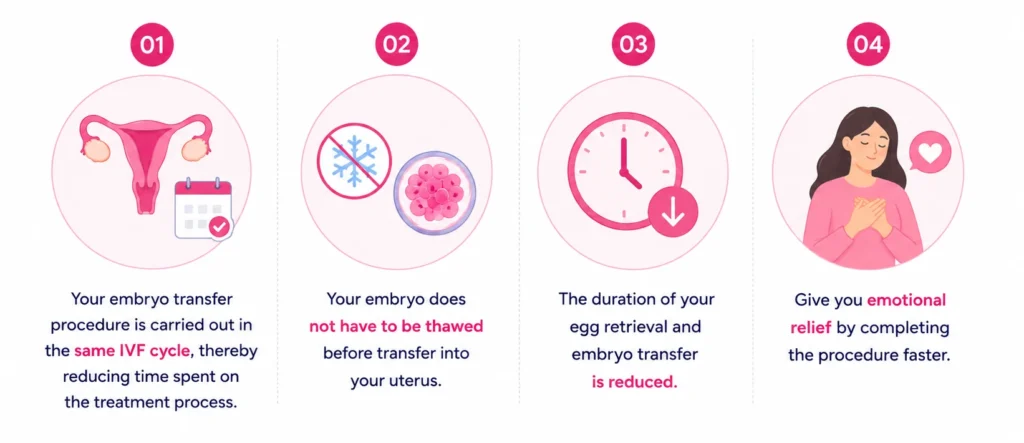
Advantages of fresh embryo transfer include the following:
- Your embryo transfer procedure is carried out in the same IVF cycle, thereby reducing time spent on the treatment process.
- Your embryo does not have to be thawed before transfer into your uterus.
- The duration of your egg retrieval and embryo transfer procedure is reduced.
- Give you emotional relief by completing the procedure faster.
Emotional well-being is also an important part of treatment, and managing stress throughout the IVF process may positively influence your overall experience.
When Do Fertility Specialists Recommend Frozen Embryo Transfer?
Frozen embryo transfer can be recommended to you in the following cases:
- You are at high risk of ovarian hyperstimulation syndrome (OHSS)
- Your endometrium is too thin or not prepared for the embryo transfer
- You suffer from PCOS or another hormone-related condition
- You had a failed implantation or IVF cycle previously
- Genetic testing of your embryos (PGT-A) is planned
- Your hormonal levels are not adequate for a fresh embryo transfer
- You want to delay pregnancy or store your embryos for future use
Are Babies Born from Frozen Embryos Healthy?
Yes, babies who are born using frozen embryos are just as healthy as those who are conceived through fresh embryos.
According to a study published in Human Reproduction, frozen embryos are associated with decreased risks of low birth weight, premature birth and babies who are small for their gestational age.
Potential Disadvantages of Fresh Embryo Transfer
During IVF, we give medicine to help your ovaries make more eggs. These medications change your hormone levels and affect your ovaries and uterine lining. As a result, fresh embryo transfer may not be suitable for every patient. In some cases, a separate embryo transfer cycle may allow the body more time to prepare for implantation.
Final Thoughts: Finding the Right IVF Approach

Choosing between fresh and frozen embryo transfer can feel overwhelming, but you do not have to make this decision alone. At Puja IVF Center in Patna, Dr Puja Kumari and her team help couples understand their options and create a treatment plan that best suits their needs and hopes for parenthood. Couples who are planning treatment often also want to understand the overall IVF cost in Patna before starting their fertility journey.
FAQs
1. Is frozen embryo transfer more successful than fresh embryo transfer?
Frozen embryo transfer has shown higher success rates in many patients, especially those with a high response to fertility medications or those undergoing preimplantation genetic testing (PGT-A). However, some women with a low ovarian reserve or poor ovarian response may achieve similar or even better outcomes with a fresh embryo transfer. Success depends on factors such as age, embryo quality, uterine health, and the cause of infertility.
2. How long can frozen embryos be safely stored?
Embryos can remain safely frozen for many years using a process called cryopreservation. When stored under proper laboratory conditions in liquid nitrogen, their quality remains stable over time. Pregnancy has been achieved from embryos stored for more than a decade, and in some reported cases, even longer.
3. Is embryo freezing safe for the embryo?
Yes. Modern vitrification (rapid freezing) techniques have made embryo freezing very safe. Most healthy embryos survive the thawing process successfully, and research shows that frozen embryo transfer is a safe and effective part of IVF treatment.
4. Can I choose a frozen embryo transfer even if I am eligible for a fresh transfer?
Yes. Some couples choose frozen embryo transfer even when fresh transfer is possible. Reasons may include scheduling flexibility, allowing the body more time to recover after ovarian stimulation, or planning genetic testing of embryos. Your fertility specialist can help determine whether this option is appropriate for you.
5. Can frozen embryo transfer be done in a natural menstrual cycle?
Yes. In selected women who ovulate regularly, frozen embryo transfer may be performed during a natural cycle without extensive hormone medication. In other cases, doctors use estrogen and progesterone to prepare the uterine lining before embryo transfer.