
The journey of IVF starts with the medical process, but at the same time, it is an emotional rollercoaster too. From the moment a couple begins, it is filled with hope, patience, and silent prayers. As the day progresses, the embryo grows, and our patients ask: What is the ideal time for embryo transfer in …

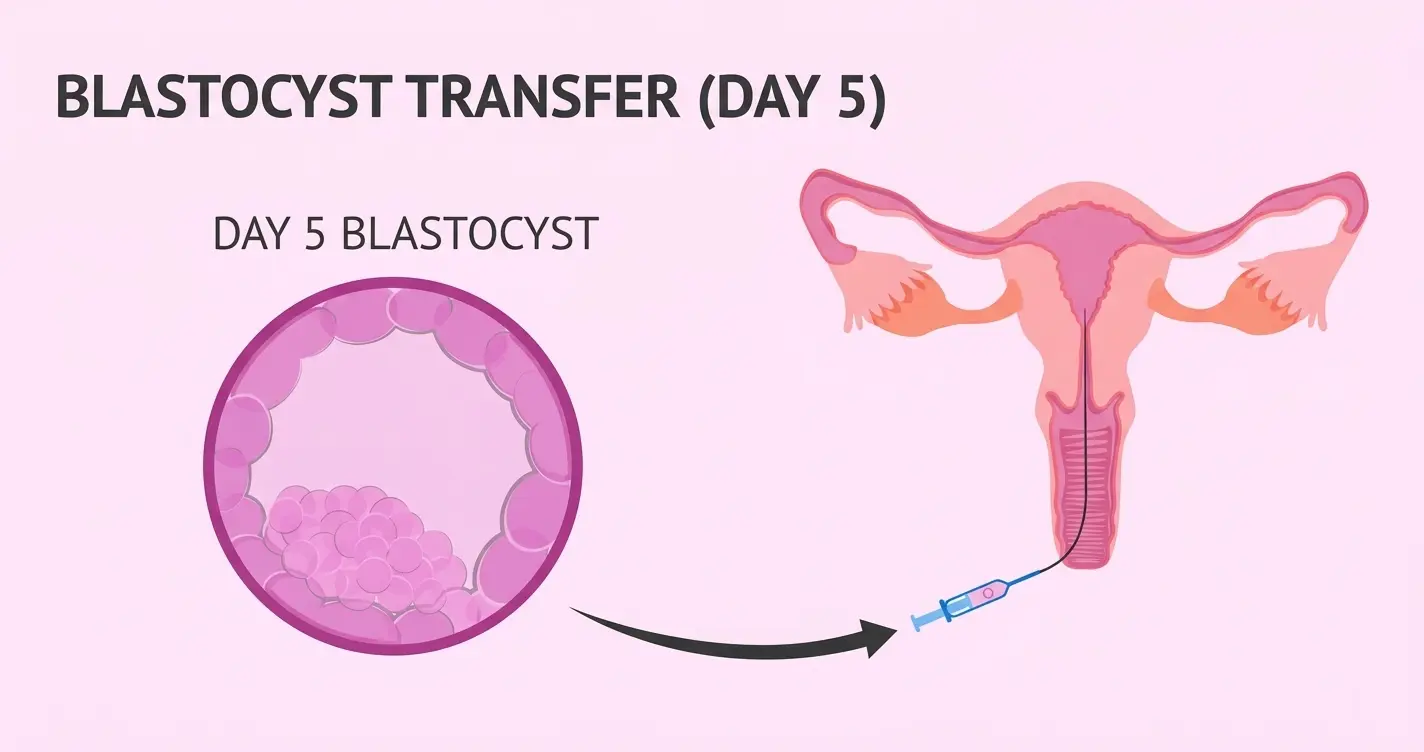
The journey of IVF starts with the medical process, but at the same time, it is an emotional rollercoaster too. From the moment a couple begins, it is filled with hope, patience, and silent prayers. As the day progresses, the embryo grows, and our patients ask: What is the ideal time for embryo transfer in the uterus?
Understanding the complete IVF treatment process can help you make informed decisions about embryo transfer timing.
We explain that embryos can be transferred at different stages, either on day 3 or day 5. At Puja IVF center, we mostly transfer embryos on Day 5 after fertilization.
But why do we wait till day 5? The embryo becomes a blastocyst on day 5, called the blastocyst stage. This choice is associated with improved day 5 blastocyst transfer success rates. Let’s break down what this approach means and how it can impact IVF success rates.
What Is a Day-5 Blastocyst Transfer in IVF?
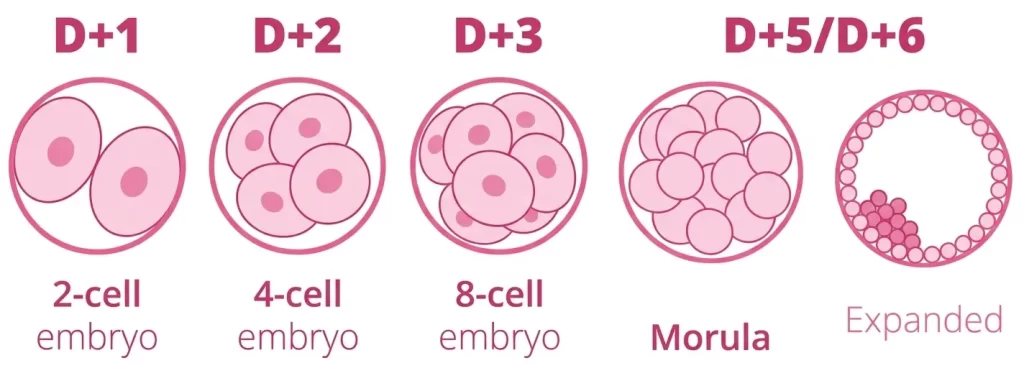
In IVF, Day-5 embryo transfer happens after the embryo grows in the lab for five days post-fertilization. During the blastocyst stage, the embryo divides into hundreds of cells.
Key parts of the blastocyst:
- Inner Cell Mass(ICM): Cells are bunched in the inner space and grow into the fetus.
- Trophectoderm: The outer cell layer that forms the placenta.
At this stage, we carefully observed the embryo in the lab to ensure it develops normally. Once the blastocyst is ready, we select the healthiest one for transfer into the uterus to match the natural timing of implantation.
Embryo Development: From Fertilization to Blastocyst Stage
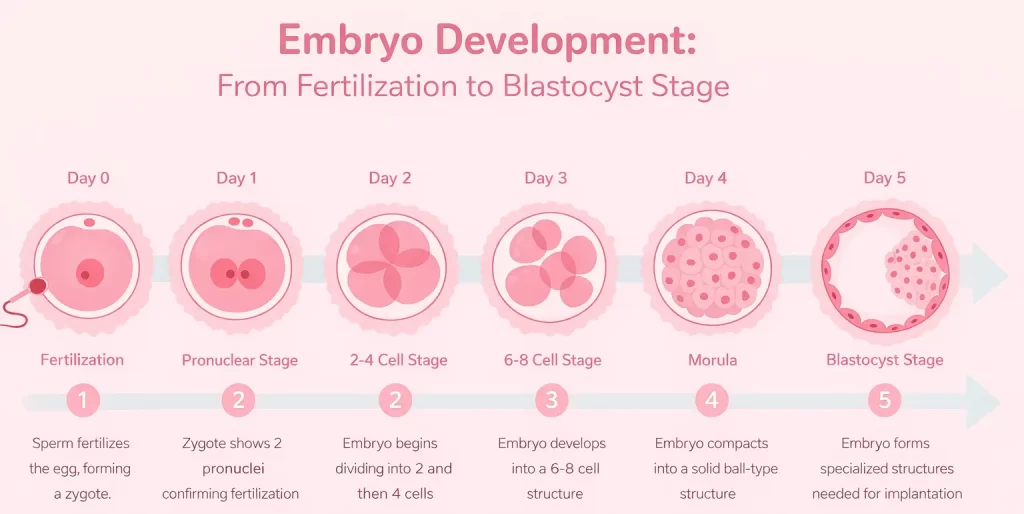
Embryo development in IVF, from fertilization to blastocyst, is the transfer of single cells into a complex structure with many cells.
Step-by-step embryo development:
Day 0: Fertilization
We collect eggs from a woman’s ovaries. These eggs are then combined with sperm in the lab. Fertilization happens either naturally in a dish (conventional insemination) or by directly injecting one sperm into an egg (ICSI).
Day 1: Pronuclear stage (Fertilization check)
Identifying 2 pronuclei (2PN) confirms successful fertilization. One comes from the egg and the other from the sperm.
Day 2: Early Cleavage stage
A fertilized egg starts dividing and forms 2 cells, and progresses to 4 cells.
Day 3: Cleavage stage
A continuously growing fertilized egg now divides into 6 to 8 cells.
Embryos with an ideal cell number and structure may be selected for transfer.
Day 4: Morula stage
The cells rapidly multiply and form a solid ball-type structure, called the morula stage.
Day 5: Blastocyst Stage
Reaching the blastocyst stage is a major milestone in embryo development. The embryo has formed specialized structures that are needed for implantation in the uterus.
The success of embryo growth also depends on several biological factors affecting the IVF success rate and lifestyle factors that influence fertility.
As we show Day-3 and Day-5, both are ideal stages for embryo transfer. But what is the difference between these two stages?
Day-3 vs Day-5 Embryo Transfer: What’s the Difference
Both options have their own benefits and indications. This table highlights the main differences to help patients understand the choices.
| Aspect | Day-3 transfer | Day-5 transfer |
| Embryo stage | Early (6–8 cells) | Advanced (blastocyst) |
| Timing | 3 days after fertilization | 5 days after fertilization |
| Number of embryos transferred | Often, 2–3 embryos to improve chances | Usually 1–2 embryos, reducing the risk of twins or triplets |
| Best for | Fewer embryos available | Multiple good‑quality embryos |
In simple terms, on day 3, the cell is still small, so we transfer it early into the uterus to continue growing inside the body. This is best when you have fewer embryos and do not want to lose them.
On the other hand, on day 5, the cell is large with advanced parts. At this time, you have many embryo so we can select the strongest for better implantation.
Key findings:
Day 3: Safer option when embryo numbers are limited.
Day 5: It offers a better selection.
To better understand your options, you can explore the difference between IUI and IVF treatments.
Embryo Grading Chart
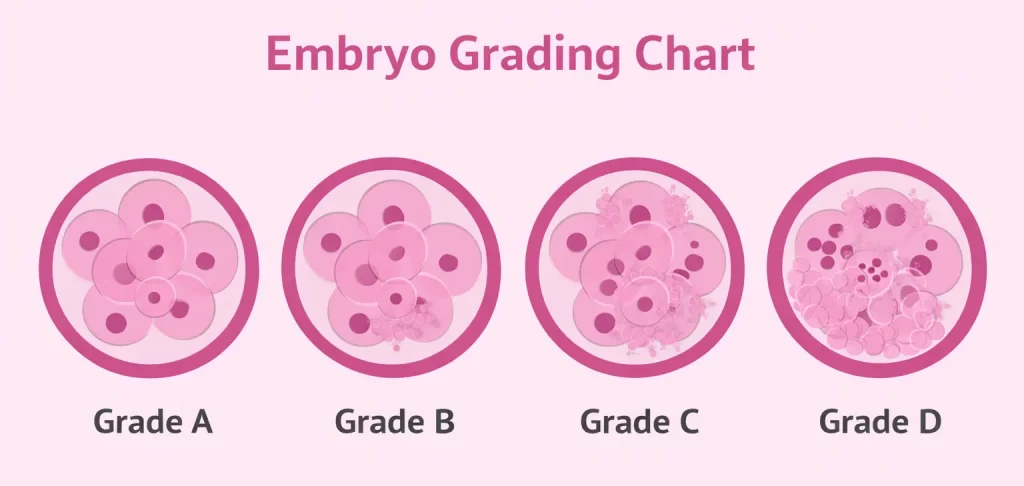
The embryo grading chart is a tool that we use to check the quality of embryos before transfer in uterus. We can do grading mostly during the blastocyst stage.
Key grading criteria:
- Expansion (how much the blastocyst has grown)
- Inner cell mass
- Trophectoderm
Each criteria is given a grade. The grading chart is like a report card for embryos, showing which ones are healthiest and most ready for transfer. Helps us to choose the healthy embryo, improving your chances of IVF success.
Does Day-5 Blastocyst Transfer Improve IVF Success Rates?
According to the American Society for Reproductive Medicine (ASRM), the advantages of blastocyst transfer are as follows:
- Higher chances of implantation rate
- Healthy embryo selection
- Improves coordination between the embryo and the uterus
- The chances of multiple pregnancies are reduced
Below are some key parameters that highlight how embryos develop and treatment outcomes.
| Parameter | Average Rates | What It Means |
Blastocyst Formation Rate | Around 40–60% embryos reach Day 5 | Only the stronger embryos keep growing |
Implantation Rate (Day‑5 | Around 50–65% | Better chance of attaching to the womb |
Pregnancy Rate Improvement | Improved by around 3–10% compared to Day‑3 | Slightly better pregnancy outcomes |
Live Birth Rate Improvement | Improved by about 3–13% compared to Day‑3 | More babies are born with this approach |
Not every embryo will reach the blastocyst stage, but the stronger ones are likely to result in a healthy pregnancy. For patients, Day‑5 blastocyst transfer offers a clearer, more hopeful step forward in the IVF journey.
However, success rates may vary depending on factors such as age, embryo quality, and overall reproductive health.
Symptoms After 5-Day Blastocyst Transfer
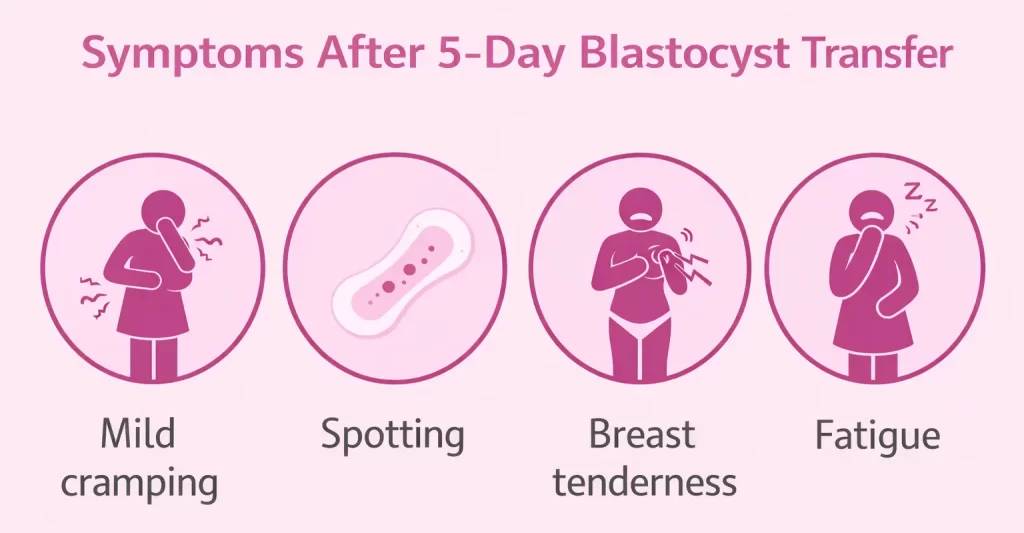
After 5 days of blastocyst transfer, some women experience mild changes as the beginning of the embryo implantation process.
Common symptoms after a 5-day blastocyst transfer are as follows:
- Mild cramping
- Spotting
- Breast tenderness
- Fatigue
These changes occur as a result of the embryo attaching to the uterine lining and the start of hormonal changes. Not every women experience same symptoms; it is vary by person to person.
Managing stress during this phase is important, as it can influence overall treatment outcomes.
Some women feel most of these symptoms, and some can not feel them, but still go through successful implantation.
Who Is a Good Candidate for Blastocyst Transfer?
Ideal candidates for blastocyst transfer are:
- Women with a good egg supply (ovarian reserve)
- Most suitable when several embryos are available
- Women who have experienced previous IVF failures
However, blastocyst transfer is not right for everyone. The decision should always be made together with a fertility specialist, who can guide each patient based on her unique situation.
And women with conditions like PCOS may require personalized treatment approaches to improve pregnancy chances.
Your Hope, Our Care – Together at PujaIVF

At Puja IVF Center, based in Patna, we encourage informed decision‑making with guidance from Dr Puja Kumari and her team. With care, expertise, and hope, we walk beside you toward the dream of parenthood.
FAQs
1. What is the success rate of a 5-day blastocyst transfer?
The success rate of a 5-day blastocyst transfer typically ranges between 50% to 70%, depending on factors such as age, embryo quality, and overall health. Blastocysts have higher implantation potential compared to Day-3 embryos because they are more developed and better selected.
2. Are Day-5 embryos better than Day-6 embryos?
Yes, Day-5 embryos are generally considered better because they develop faster and show stronger growth. They often have higher implantation and pregnancy rates. However, high-quality Day-6 embryos can still lead to successful pregnancies.
3. When does implantation occur after a 5-day blastocyst transfer?
Implantation usually begins 1 to 2 days after transfer and may take around 4 to 5 days to complete. However, timing can vary depending on the individual and embryo quality.
4. Which embryo grade has the highest success rate?
High-quality embryos such as 4AA or 5AA blastocysts have the highest success rates. These embryos have well-developed inner cell mass and outer cells, increasing the chances of implantation and pregnancy.
5. Is blastocyst transfer better than early embryo transfer?
Yes, blastocyst transfer is often better because it allows natural selection of stronger embryos and improves synchronization with the uterus, leading to higher success rates in many cases.
6. How many embryos reach the blastocyst stage?
On average, only 30% to 50% of fertilized embryos reach the blastocyst stage. This is a natural selection process where only the strongest embryos continue developing.